
















- Contact Us
- Emergency Information
- Facility Rental
- Jobs
- Site Map
- Site Policies
- Web Accessibility
- Web Privacy
- © Harry Ransom Center 2025

SIGNATURES
Identified individuals are represented by a biographical sketch, a list of connections to other signatures, and, in most cases, an artifact from the Ransom Centers collections. Help us identify more signatures by submitting your suggested identification.
X
X
X
X
THE DOOR
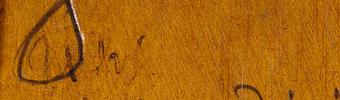
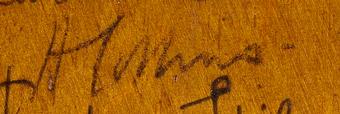
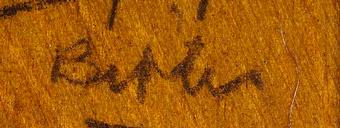
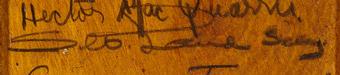
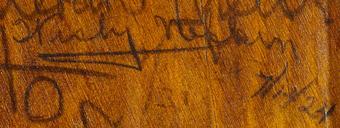
 Location on door: front, panel 1
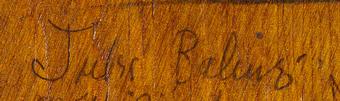
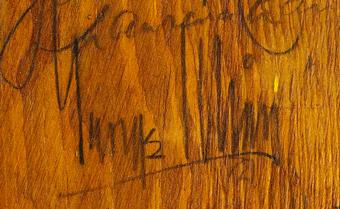
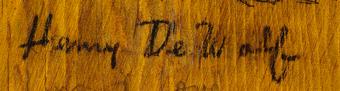
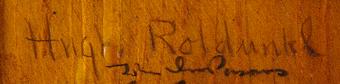
ROBERT L. WOLF
Writer Robert Leopold Wolf (b. 1895) rebelled against his wealthy upbringing to live a bohemian lifestyle. A year after graduating from Harvard in 1915, he was written up in the press for marrying his first wife, a Bryn Mawr student, by the unconventional means of signing of a joint contract. In the 1920s he lived in New York, where he met and married his second wife, poet Genevieve Taggard. He published verse and stories in a variety of little magazines and wrote one of the first reviews (for the New York World) of E. E. Cummings's debut collection of verse, Tulips and Chimneys (1923). Together with Taggard and several other door signatories, Wolf served as a contributing editor of the leftist journal New Masses. Wolf's marriage to Taggard was tempestuous, and the couple divorced not long after Wolf was institutionalized for mental illness in the early 1930s.
- View page turner
- View metadata
X
Creator: Wolf, Robert L., 1895-
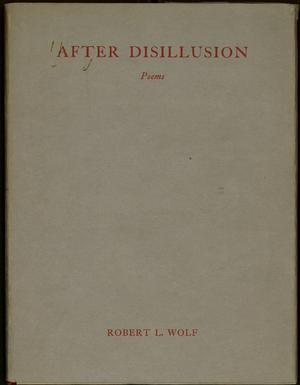
Title: After Disillusion
Description: Cover, title page, inscription to Christopher Morley, and the poem "The Public," page 34
Imprint: New York: Thomas Seltzer, 1923
Item Date: 1923
Material Type: Monographs
ADA Caption: After Disillusion
Curatorial Department: Book Collection
Collection Name: Christopher Morley Collection
Stack Location: PS 3545 O3 A4 MOR
Copyright Notices: Some of the documents shown here are subject to U. S. copyright law. It is the user's sole responsibility to contact the copyright holder and secure any necessary copyright permission to publish documents, texts, and images from any holders of rights in these materials. As the owner of the physical object (not the underlying copyright), the Ransom Center requires that you also contact us if you wish to reproduce an image shown here in a print publication or electronically.
Every effort has been made to trace copyright ownership and to obtain permission for reproduction. If you believe you are the copyright owner of an item on this site, and we have not requested your permission, please contact us.
X
The cover, author's inscription to Christopher Morley, title page, and "The Public" from Robert L. Wolf's After Disillusion (New York: Thomas Seltzer, 1923)
Robert L. Wolf's volume of poetry, After Disillusion was published by Thomas Seltzer in 1923. Though its themes are often bohemian and anti-establishment, its forms are relatively conventional. Wolf's inscription to writer Christopher Morley references a poem in the collection that satirizes an attention-seeking, avant-garde poet named "Goliath."