


Identified individuals are represented by a biographical sketch, a list of connections to other signatures, and, in most cases, an artifact from the Ransom Centers collections. Help us identify more signatures by submitting your suggested identification.
X































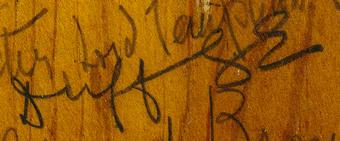


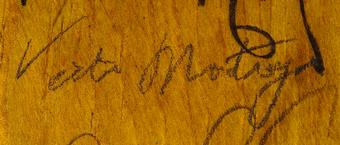
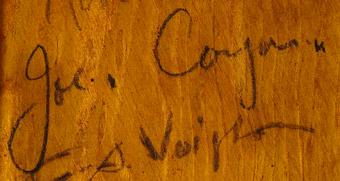


X
X
X
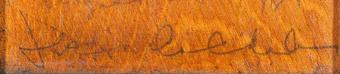
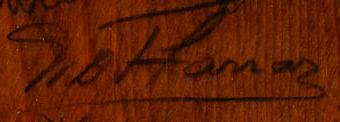
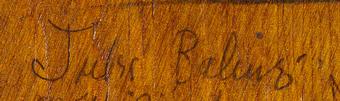
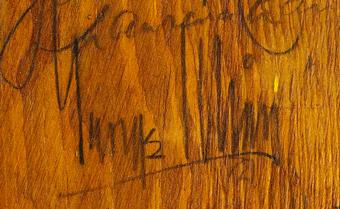
 Location on door: front, panel 1
THEODORE DREISER
The great naturalist novelist Theodore Dreiser (1871-1945) was born into poverty in Terre Haute, Indiana. In his early years, he struggled to make a living as a newspaper reporter in Chicago, St. Louis, Pittsburgh, and, finally, New York City, where he moved in 1894. After finding work editing and writing columns for magazines, he published his first novel, Sister Carrie, in 1900. Over the next several years he worked as a magazine editor, and only after the success of his novel Jennie Gerhardt (1911) was he able to write full-time. He moved to Greenwich Village in 1914, residing in Patchin Place, home to many notable writers. He published his work in the Masses and other left-wing periodicals, and had affairs with several women, among them Kirah Markham, an actor with the Provincetown Players. He began to write experimental plays and to become interested in theories of psychoanalysis, which was popular among Villagers at the time. During these years he became friends with Frank Shay, owner of the Washington Square Bookshop at the time. The two planned for Shay to publish a new edition of Sister Carrie, but Shay was drafted to serve in World War I before he could do so. Shay introduced Dreiser to Horace Liveright, who published the edition instead, beginning Dreiser's long relationship with the publishers Boni and Liveright. The 1925 publication of his novel An American Tragedy confirmed Dreiser's reputation as a major American novelist. He continued to write both novels and social commentary for many more years, and lived off and on in New York for much of his life.
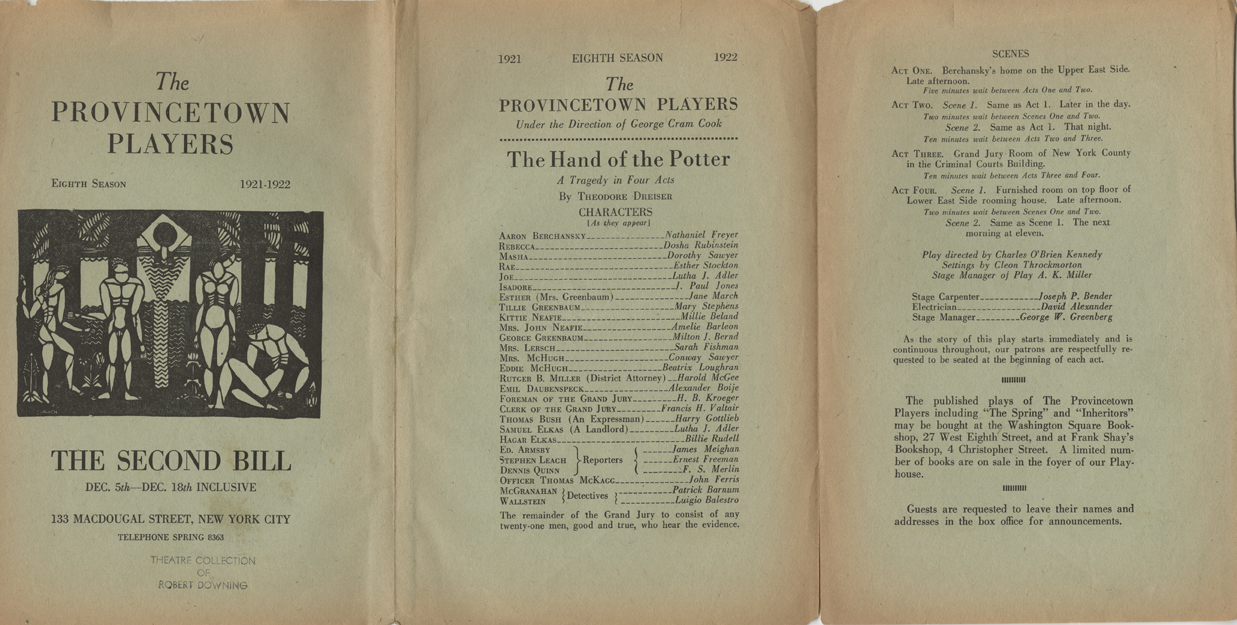
- View larger image
- View metadata
X
Creator: Provincetown Players
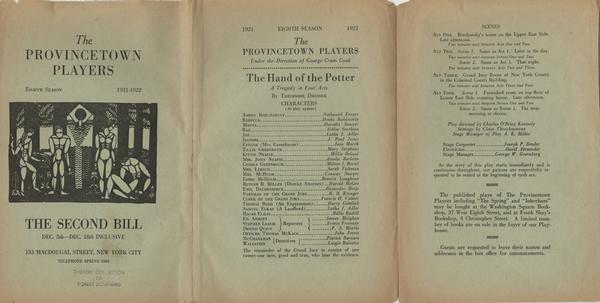
Title: Playbill for Theodore Dreiser's The Hand of the Potter
Description: From the play's premiere, 5-18 December 1921
Item Date: 1921
Material Type: Playbills
ADA Caption: Playbill from Theodore Dreiser's The Hand of the Potter
Curatorial Department: Performing Arts Collection
Collection Name: Playbills and Programs Collection: New York City Theaters
Stack Location: New York Theaters, 1922
Copyright Notices: Some of the documents shown here are subject to U. S. copyright law. It is the user's sole responsibility to contact the copyright holder and secure any necessary copyright permission to publish documents, texts, and images from any holders of rights in these materials. As the owner of the physical object (not the underlying copyright), the Ransom Center requires that you also contact us if you wish to reproduce an image shown here in a print publication or electronically.
Every effort has been made to trace copyright ownership and to obtain permission for reproduction. If you believe you are the copyright owner of an item on this site, and we have not requested your permission, please contact us.
X
A playbill for the Provincetown Players's production of Theodore Dreiser's The Hand of the Potter, 1921.
Dreiser's play, a tragic tale of a sexual criminal who murders an 11-year-old girl, was published in 1918, but was not produced until the Provincetown Players's production represented here. The play's tragic element rests in the murderer's inability to control his deeply-rooted impulses, and alludes to emergent psychological theories of the time.