


Identified individuals are represented by a biographical sketch, a list of connections to other signatures, and, in most cases, an artifact from the Ransom Centers collections. Help us identify more signatures by submitting your suggested identification.
X

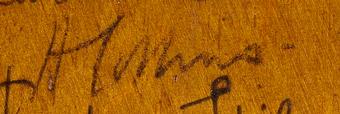
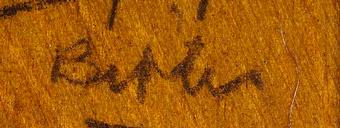


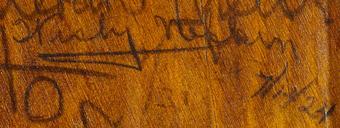







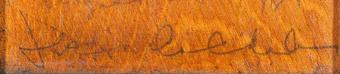
















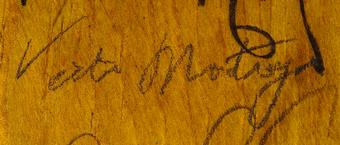
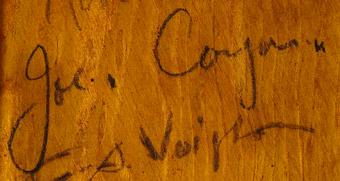


X
X
X
 Location on door: front, panel 2
SHERWOOD ANDERSON
The great short-story writer, Sherwood Anderson (1876-1941), is known best for his works set in small-town Ohio, his home state. He came to literature late, leaving a conventional life in business in 1912 after suffering a breakdown; the story of this change later became a model of sorts for other writers seeking to break with "Main Street" American norms. Anderson's writing career began in earnest when he moved to Chicago. While writing advertising copy there he became acquainted with Floyd Dell and Margaret Anderson, who published an essay by Sherwood Anderson in the Little Review in 1914. Dell moved to New York and as an editor at The Masses published some of the short stories that were to be collected in Anderson's best-known book, Winesburg, Ohio (1919). With another critical success, the novel Poor White (1920), and extensive publication in periodicals, Anderson's fame grew. He resided in Greenwich Village off and on in the early 1920s, at one point living just a few doors from his friend Theodore Dreiser, another Chicago transplant. Anderson finally settled in Virginia in the late 1920s, but continued to visit Greenwich Village. A very public presence on the literary scene, Anderson lectured widely on literature and was known for fostering the careers of other writers, most notably providing Ernest Hemingway with his introduction to Gertrude Stein.
- View larger image
- View metadata
X
Creator: Anderson, Sherwood, 1876-1941
Title: Letter to Alice Corbin Henderson
Item Date: 24 May 1917
Material Type: Manuscript
ADA Caption: Letter to Alice Corbin Henderson
Curatorial Department: Manuscripts Collection
Collection Name: Alice Corbin Henderson Collection
Stack Location: Box 1, Folder 5
Copyright Clearance: Grateful acknowledgement is made to the Sherwood Anderson Estate for permission to display this artifact.
Copyright Notices: Some of the documents shown here are subject to U. S. copyright law. It is the user's sole responsibility to contact the copyright holder and secure any necessary copyright permission to publish documents, texts, and images from any holders of rights in these materials. As the owner of the physical object (not the underlying copyright), the Ransom Center requires that you also contact us if you wish to reproduce an image shown here in a print publication or electronically.
Every effort has been made to trace copyright ownership and to obtain permission for reproduction. If you believe you are the copyright owner of an item on this site, and we have not requested your permission, please contact us.
X
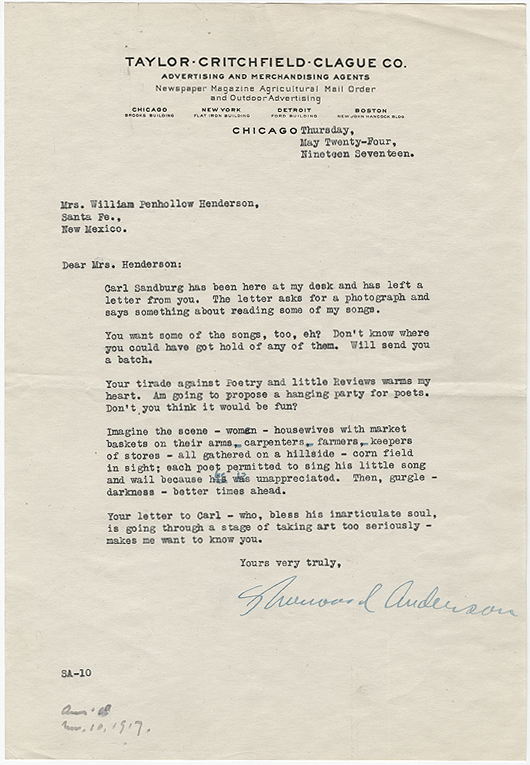
A letter from Sherwood Anderson to Alice Corbin Henderson, May 24, 1917
In this letter, Anderson shares his delightfully salty comments on friend and Chicago poet Carl Sandburg and the state of poetry. Not long before Anderson wrote this letter, Henderson had been a visible feature in the Chicago literary scene, but tuberculosis forced her to move to New Mexico, where she remained permanently. Assistant editor at Harriet Monroe's Poetry magazine, she continued working for the magazine from a distance until 1922 until editorial differences of opinion caused a split.