


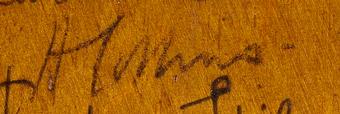
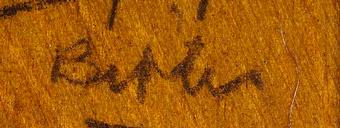
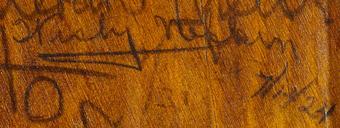
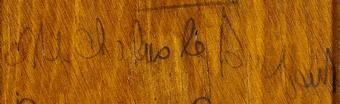
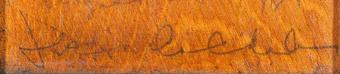
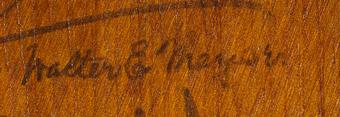
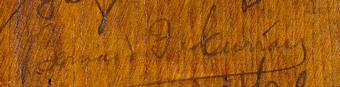
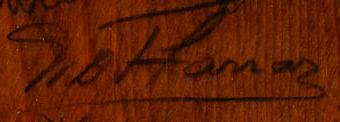
Identified individuals are represented by a biographical sketch, a list of connections to other signatures, and, in most cases, an artifact from the Ransom Centers collections. Help us identify more signatures by submitting your suggested identification.
X




















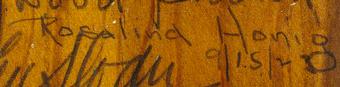

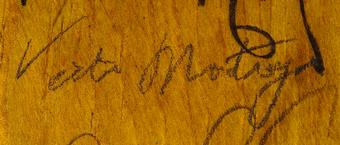
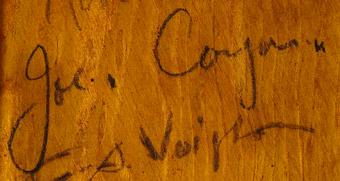

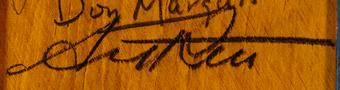
X
X
X
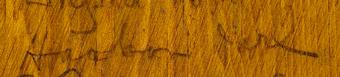
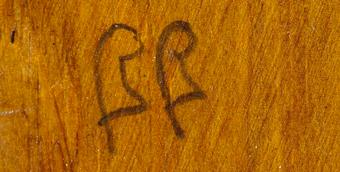
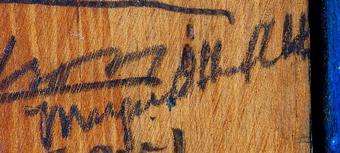
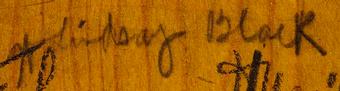
 Location on door: front, panel 2
ROBERT CORTES HOLLIDAY
Robert Cortes Holliday (1880-1947) participated in all aspects of the literary profession. Born in Indianapolis, he moved to New York to study at the Art Students' League and worked briefly as an illustrator for periodicals. He then sold books, worked as a librarian, and became a literary editor at the New York Tribune, Doubleday, Page & Co., and George H. Doran & Co. before taking an editorial position with The Bookman, serving as its chief editor from 1919 to 1920. After he left The Bookman in 1923, Holliday continued his criticism, worked for brief stints in advertising, and in 1926 became an instructor on writing for publication. Holliday also published fifteen books, including The Walking-Stick Papers (1918), Men and Books and Cities (1920), Literary Lanes and Other Byways (1925), as well as volumes on Booth Tarkington and poet Joyce Kilmer (for whom he served as literary executor). Writer and friend, Christopher Morley, wrote of Holliday: "[he] has the genuine gift of the personal essay, mellow, fluent, and pleasantly eccentric."
- View page turner
- View metadata
X
Creator: Holliday, Robert Cortes, 1880-1947
Van Rensselaer, Alexander, 1892-1962
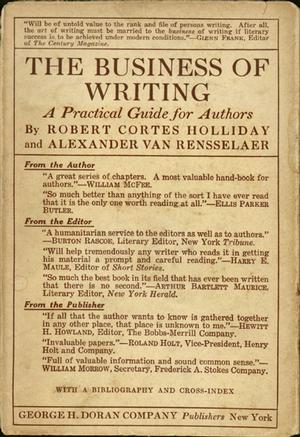
Title: The Business of Writing: A Practical Guide for Authors
Description: Dust jacket, Holliday's inscription to Christopher Morley, table of contents on pages xvii-xx, and Chapter XIII "The New Bookshops," pages 251-269
Imprint: New York: George H. Doran Company, 1922
Item Date: 1922; inscription 6 November 1922
Material Type: Monographs
ADA Caption: The Business of Writing: A Practical Guide for Authors
Curatorial Department: Book Collection
Collection Name: Christopher Morley Collection
Stack Location: PN 145 H6 MOR
Copyright Notices: Some of the documents shown here are subject to U. S. copyright law. It is the user's sole responsibility to contact the copyright holder and secure any necessary copyright permission to publish documents, texts, and images from any holders of rights in these materials. As the owner of the physical object (not the underlying copyright), the Ransom Center requires that you also contact us if you wish to reproduce an image shown here in a print publication or electronically.
Every effort has been made to trace copyright ownership and to obtain permission for reproduction. If you believe you are the copyright owner of an item on this site, and we have not requested your permission, please contact us.
X
The front of dust jacket, author's inscription to Christopher Morley, table of contents, and Chapter XIII, "The New Bookshops" from Robert Cortes Holliday and Alexander Van Rensselaer's The Business of Writing: A Practical Guide for Authors (New York: George H. Doran Company, 1922)
In a chapter titled "The New Bookshops," Holliday and Van Rensselaer discuss the flourishing of "little bookshops," a phenomenon whose epicenter they locate in Greenwich Village. In the Village, they explain, the emphasis is on "first-rate" books. "Best sellers" are treated with skepticism and are sometimes slipped surreptitiously to the buyer as though s/he were purchasing "some hooch."